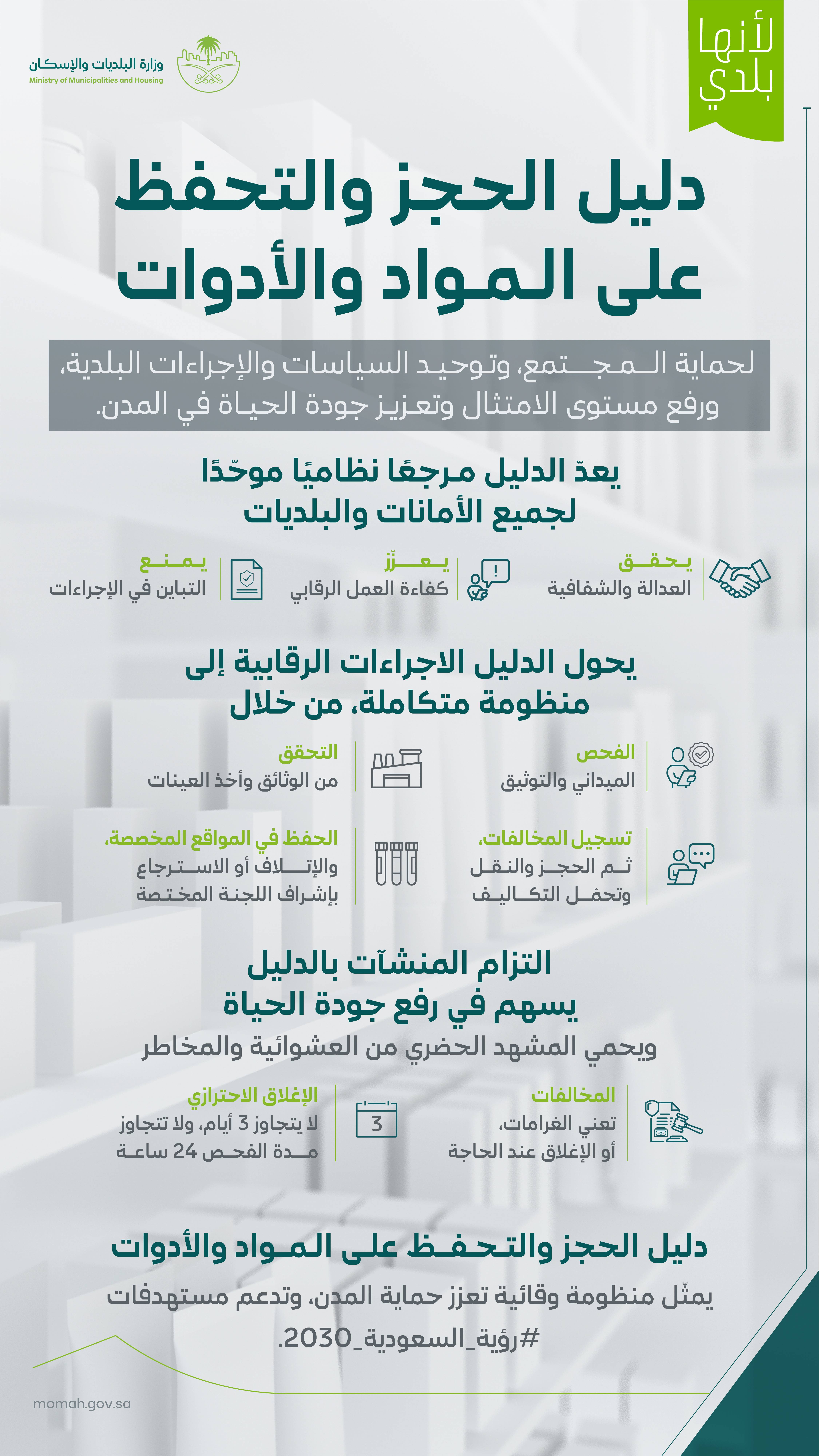
The Ministry of Municipalities and Housing has approved the Guide for Confiscation and Custody of Materials and Tools, a regulatory step aimed at unifying municipal policies and procedures, raising compliance with laws and regulations, safeguarding public health and safety, and enhancing quality of life in Saudi cities.
The Ministry explained that the adoption of the guide is based on the Municipal Violations Penalties Regulation and its executive rules, serving as a unified legal reference to be applied across all secretariats and municipalities. This strengthens oversight efficiency, prevents inconsistencies in procedures, and ensures fairness and transparency in law enforcement.
The guide regulates procedures for confiscating non-compliant materials and tools, outlining mechanisms for their transport and storage in designated facilities equipped with the necessary technical requirements. Violators are responsible for covering transport and guarding costs, and the guide ensures that confiscated items are not used during custody. It also specifies cases requiring precautionary temporary closure of establishments to protect public health and safety.
The Ministry noted that the guide includes procedures for destroying unsafe or hazardous materials and tools under the supervision of specialized technical committees, with violators bearing the associated costs. It also regulates mechanisms for reclaiming confiscated items after fines are paid and legal requirements are met, and allows for the auctioning of unclaimed items.
Detailed mechanisms are provided to address different cases, such as large-sized materials and tools that are difficult to transport, where samples may be taken for testing on-site. The guide also mandates immediate handling of perishable materials by sending samples directly to the relevant authority within 24 hours of confiscation, with testing periods not exceeding three days, and requires suitable storage facilities until examinations are completed.
The guide stipulates that precautionary closure of a shop or establishment may not exceed three consecutive days and cannot be extended under any circumstances. Sites may be reopened if no grounds are found to justify continued closure, ensuring procedural integrity and protecting public health.
This initiative is part of the Ministry’s ongoing efforts to strengthen the implementation of laws and regulations, develop oversight and regulatory tools, and support the objectives of Saudi Vision 2030 in improving the urban landscape, enhancing compliance, and achieving higher standards of safety and quality of life.
The Guide for Confiscation and Custody of Materials and Tools can be accessed through the following link: https://momah.gov.sa/sites/default/files/2025-09/dlyl_alhjz_walthfz_%60ly_almwad_waladwat%20%20V%2017.1alnskht%20alnhayyt.pdf.